
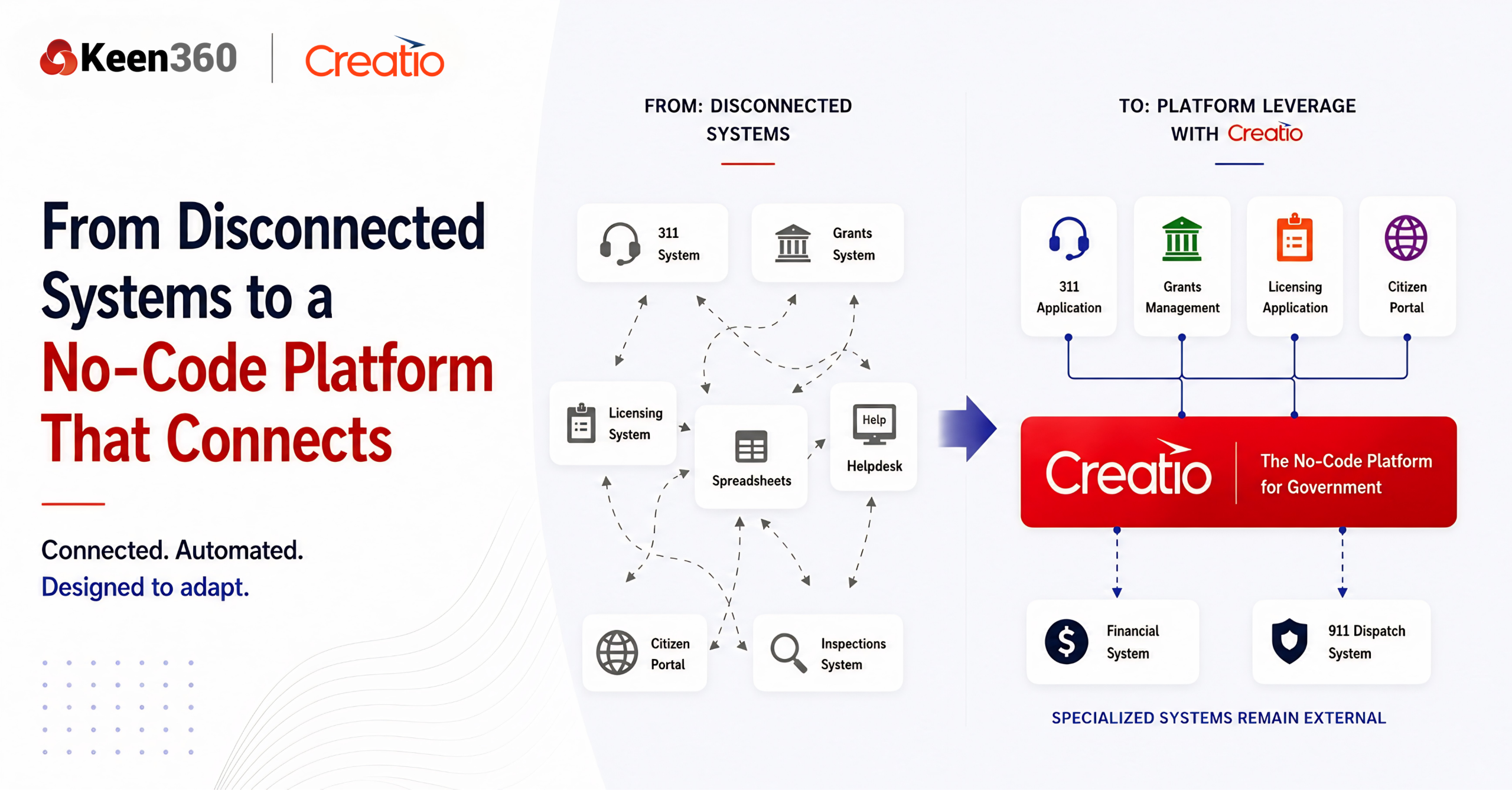
The point is not modernization for its own sake; it is better service, trust, transparency, and access.
Additional Perspective: IDC Spotlight: Transforming Government Customer Service
From Replacing Systems to Creating Options
At Keen360, we’ve seen this shift play out in large municipalities. The City of Boston implements Creatio for a specific use case—say, a 311 operation. Initial deployment is measured in months, not years. Users adopt it. Leadership sees results.
Then, the unforeseen arises. A new, time-sensitive requirement emerges—driven by policy, external pressure, or a mandate. There isn’t time to procure and implement a new system in the traditional way. The organization needs to stand something up quickly, and it needs to work.
In Boston, for example, the City was in the process of implementing Creatio CRM for its 311 operations when a mandate came from the State and Mayor’s office to deploy a distributed application to support election-related processes—under a compressed timeline. Not as a pilot, but as a real operational system.
Because Creatio was already in place—and because the City’s IT team had already begun developing no-code skills—the team was able to design, build, and deploy the new application in a matter of weeks, something that would have been difficult, if not impractical, on the legacy platforms available to it.
Moments like this change how leadership views the platform. Confidence builds. What began as a single application becomes something more: a platform that can be used to modernize additional systems, reduce reliance on fragmented tools, and improve service delivery across departments — a core objective of government CRM.
At that point, the question is no longer whether the platform works. The question becomes where it fits across the broader application portfolio.
Where Creatio Fits: A Practical Model
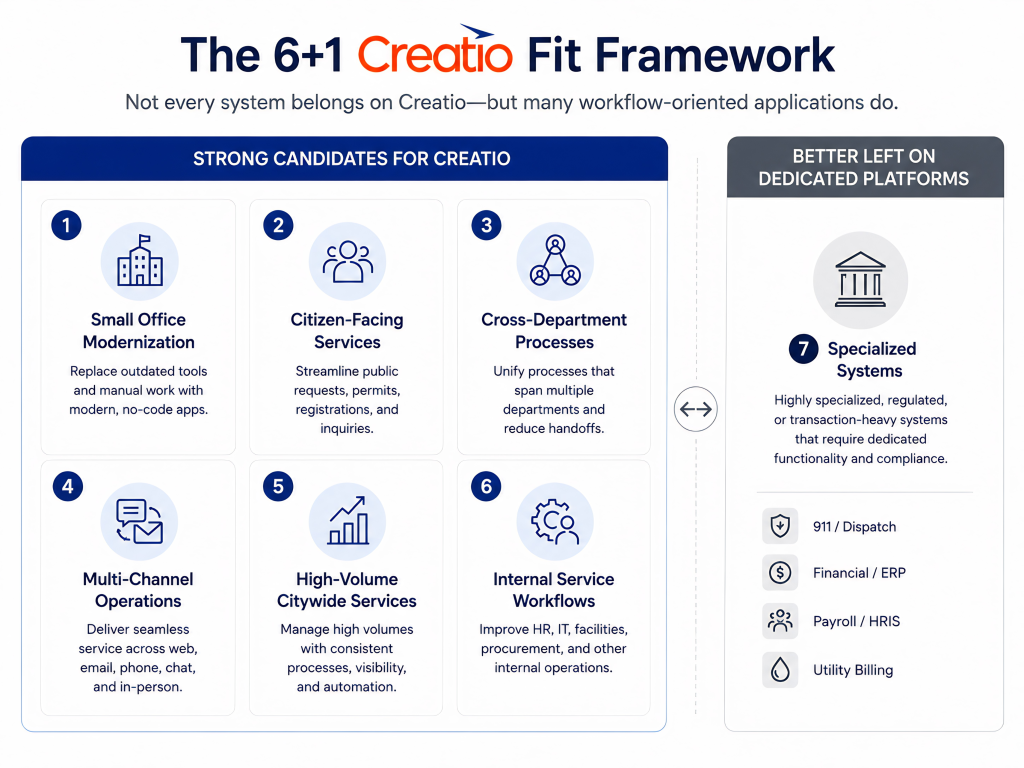
Within state and local governments, a consistent pattern emerges. Some types of applications map naturally to the Creatio platform,. Others do not—and should not.
A simple way to think about government workflow automation use cases is this: six categories are strong candidates for Creatio. A seventh belongs elsewhere.
1. Small Office Modernization
Offices still relying on spreadsheets, email chains, or lightweight databases. These are often the fastest wins—moving to structured workflows, clearer ownership, and better visibility.
2. Citizen-Facing Services
Applications where residents submit requests, applications, or complaints and track status. These benefit from clear intake, case tracking, and communication — a common use case for public sector CRM.
3. Cross-Department Processes
Work that spans multiple offices—grants, permitting, economic development, investigations. These tend to break down at handoffs. Creatio CRM is well suited to these handoffs because workflow is central to the platform.
4. Multi-Channel Operations
Services that take input from phone, email, web, and mobile. The need here is consistency—one system of record regardless of channel.
5. High-Volume Citywide Services
Operations like 311 or large public programs, where scale, repeatability, reporting, and operational visibility matter.
6. Internal Service Workflows
HR, IT, procurement, and facilities requests. In many organizations, internal users still rely on clunky, manual processes even when public-facing services have improved. Fixing that often produces immediate gains.
Then there is a seventh category:
7. Specialized Systems
911 dispatch, payroll, core financials, utility billing. These are highly specialized or tightly regulated. They are better left on dedicated platforms.
This distinction matters. Not everything belongs on Creatio. But a meaningful portion of a municipal or state application portfolio does—and that is where Creatio government CRM delivers value.
Why This Pattern Holds
The six categories of teams and applications align well with Creatio for a few straightforward reasons.
Much of government work is built around cases, requests, approvals, and reporting. Whether the “customer” is a resident or an employee, the pattern is similar—and Creatio is built to handle it.
Government environments also change. Programs evolve. Policies shift. New requirements appear quickly. Long development cycles struggle to keep up. Configurable platforms tend to hold up better over time.
This broader shift aligns with Gartner’s government technology trends for 2024, which highlight growing adoption of platform-based and low-code approaches to improve agility and accelerate service delivery.
Related Research: Gartner’s government technology trends for 2024
There is also the issue of fragmentation. Most agencies accumulate systems over time—each solving a specific problem. The result is a mix of tools that don’t connect well and are costly to maintain. A platform approach reduces that sprawl without pretending that every application belongs on the same instance or even the same platform.
Finally, most agencies are working with lean IT teams and constrained budgets. Platforms that reduce reliance on specialized development and allow teams to make controlled changes themselves are simply easier to sustain.
This is one reason low-code and no-code platforms are increasingly attractive to government organizations operating with constrained technical staffing and growing service expectations.
Related research: ICF on Low-Code Workforce Enablement
As agencies look ahead to incorporating AI, Creatio’s combination of workflow, structured data, and embedded AI capabilities becomes even more relevant for modern public-sector CRM strategies. These capabilities include AI agents for government services, helping agencies automate service requests, assist employees, and orchestrate complex workflows.
Creatio’s broader AI-native platform strategy is centered on embedding AI directly into workflow automation, case management, and operational decision-making — not as a separate toolset, but as part of the operational platform itself.
The Role of Pre-Configured Applications
Another advantage of the Creatio platform is that organizations do not need to start from scratch.
Pre-configured applications—such as those from Keen360 for citizen services, 311 operations, grants management, and incentives programs—provide a starting point based on proven public-sector workflows. These can be deployed quickly and then adapted to local needs using the platform’s no-code tools.
This shortens time to value while still allowing flexibility. It also reinforces the idea of building a connected set of applications, rather than a series of one-off systems.
Organizations can also accelerate deployment through Creatio Marketplace solutions and pre-configured public-sector applications tailored to common workflow patterns.
The Right Way to Think About Modernization
Modernization does not come from planning and buying one system at a time. It comes from adopting a platform that can support many needs over time.
Equally important: platform strategy does not mean forcing everything onto a single, monolithic system. Government and enterprise IT have already run that experiment. It leads to unintended complexity, rigidity, and eventual failure.
The Creatio platform enables a more practical approach: consolidate where consolidation makes sense, and federate where federation makes sense.
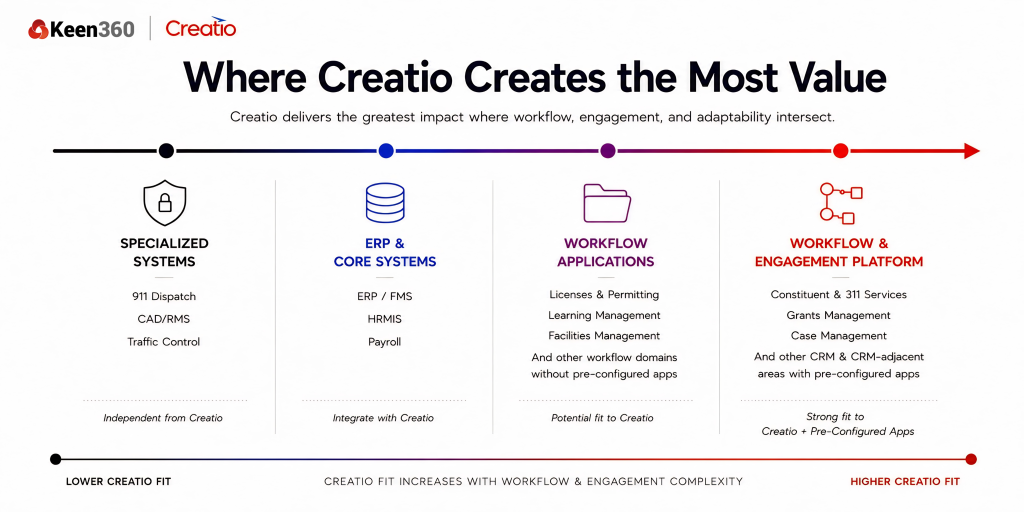
To be clear, consolidation does not mean every Creatio-powered application must run on the same Creatio instance. That would simply recreate the old monolithic model under a new name. The better approach is more nuanced: use Creatio as a shared platform foundation, while allowing separate Creatio-powered applications or instances where organizational structure, security, scale, or operational needs call for separation. Federation also extends to non-Creatio applications, for example financial management systems.
The value of platform-driven modernization comes from:
- A single set of no-code skills for configuring and extending applications across multiple domains.
- Faster deployment cycles without rebuilding from scratch each time.
- Consistent patterns for workflow, case management, automation, and reporting.
- A practical path to incorporating AI agents into day-to-day operations.
That first point matters more than it may seem. When teams can apply the same no-code skills across multiple applications, delivery accelerates, reliance on scarce technical resources decreases, and the organization becomes genuinely adaptable over time.
The operating model changes as a result. Instead of asking, “What system do we need for this use case?” the question becomes: “Given the fit, why would we not support this on our enterprise no-code, AI-native platform?”
Deloitte’s government operating model research similarly emphasizes that AI, automation, and adaptive operating models are reshaping how public-sector organizations modernize services and deploy digital capabilities.
Related research: Deloitte’s Government Operating Model and AI Transformation Trends
A Structured Approach to Assessment

The question is not whether to move in this direction—it is how to do so, and where to start. The answer requires a clear view of the current IT portfolio: what belongs on Creatio, what does not, and how the financials look.
Keen360 works with CIOs and IT leaders to develop that view through a focused, short-duration assessment. The objective is to produce a practical, executive-level output:
- Which offices and applications are strong candidates for Creatio CRM software,
- What implementation and licensing costs are likely to be,
- Where consolidation can reduce ongoing spend without compromising operations, and
- How service delivery and citizen experience can be improved.
Just as importantly, the assessment defines how to balance consolidation with independence—what should move to the platform, what should remain separate, and how everything connects over time.
The result is a working blueprint and roadmap. Not a long strategy exercise, but something concrete enough to support organizational alignment and financial planning.
Looking Ahead—and Getting Started
We will explore these ideas further in future posts, including deeper looks at specific application types and practical approaches to platform adoption.
For now, the takeaway is simple.
Government organizations are not choosing Creatio merely to replace a single CRM system. They are choosing the Creatio as a platform that provides a practical way to modernize a meaningful portion of their application portfolio—while improving service to the public.
The broader modernization trend is increasingly focused on improving transparency, responsiveness, and citizen experience—not modernization for its own sake.
If you are evaluating how Creatio might fit within your organization, Keen360 can help. We work with public sector leaders to explore use cases, demonstrate what is possible on the platform, and develop a clear, prioritized roadmap.
Reach out to schedule a conversation or demonstration. A short discussion is often enough to identify where the opportunity begins.